
Jonesboro City Directory Holdings
Jonesboro directory research begins with a short but useful set of confirmed holdings. The Genealogy Society of Craighead County, or GSCCA, has placed the 1906 volume online. Separate institutional listings confirm selected midcentury city volumes, telephone-directory runs, a newspaper obituary index, census sources, a fire-insurance map set, and cemetery books. Each source records a different slice of life. A directory may place a named person at an address, while a map describes the structure and a census identifies the household.
| Jonesboro collection | Confirmed years | Custodian or shelf | Way to consult it |
|---|---|---|---|
| Jonesboro city directory | 1906 | GSCCA | Free digitized pages |
| Selected Jonesboro directories | 1936, 1939, 1947, 1951, 1953, 1956, 1959 | St. Louis County Library listing | Microfilm; seek a local or interlibrary copy |
| Jonesboro/Nettleton telephone directories | November 1937 to September 1952; September 1953 to October 1959 | Library of Congress catalog and collections | Catalog-dependent online or institutional access |
| Federal census | Craighead schedules from 1860; public through 1950 | NARA, library databases, indexed society volumes | Online or library access |
| Jonesboro Sanborn map | July 1919, 30 sheets | Library of Congress | Free digital images |
| Obituary and cemetery indexes | Coverage varies | GSCCA, city cemetery staff, public library | Web index, reference copy, or plot request |
The confirmed directory chronology is not continuous. A missing year in a catalog does not prove that no volume was printed. The public library overview also does not list every title on its shelves. Ask staff for an inventory by title, year, format, and publisher, including historical directories, reverse or criss-cross books, and telephone books. That request keeps gaps visible instead of turning them into false conclusions.
Jonesboro's 1906 Directory Online
The GSCCA digitized 1906 Jonesboro directory is the clearest online starting point. It predates the 1910 census and modern statewide vital registration, so it can supply a dated bridge between later official records. Search an exact surname first, then inspect initials, spouse notations, street entries, occupations, and nearby names. Transcribe the wording as printed. A changed initial or shortened given name may be the clue that joins two records.
The captured collection page shows how the society provides local directory access.
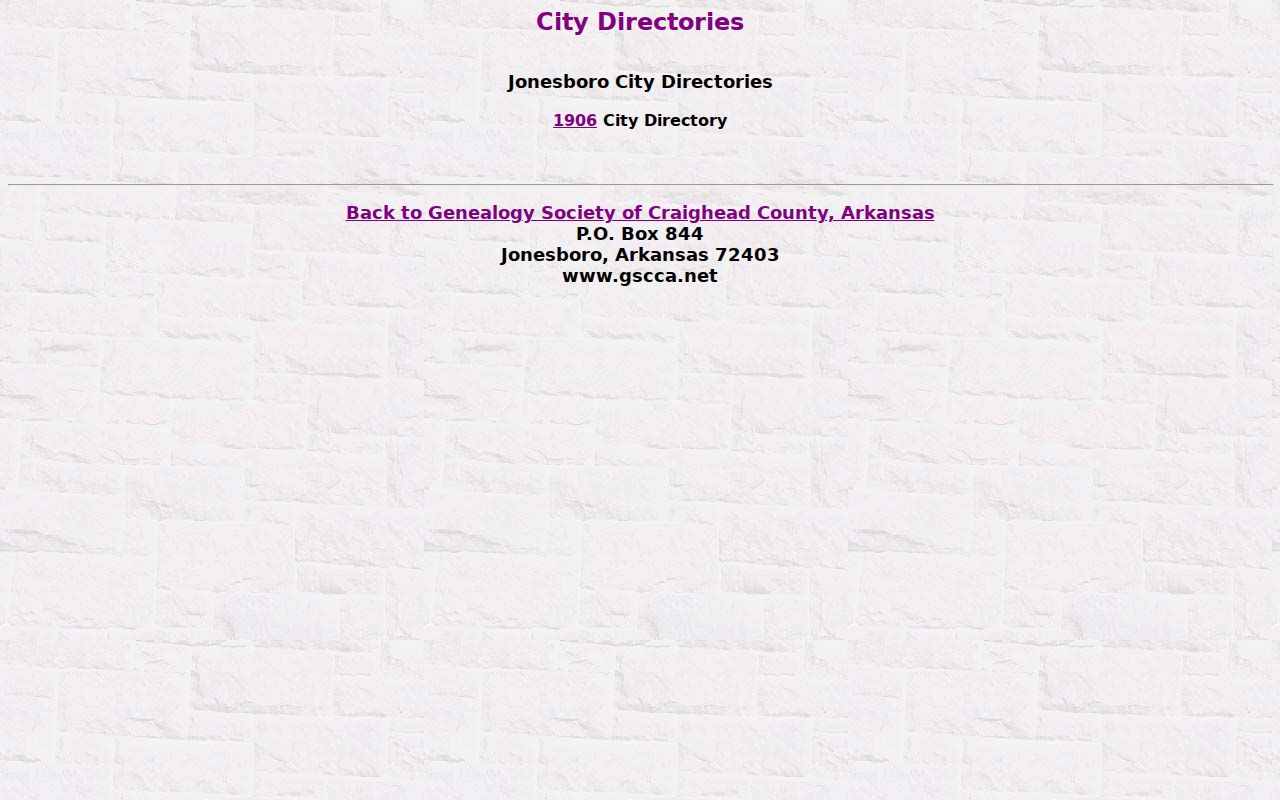
The image is an entry point, not a substitute for checking the scanned title page and abbreviation list. Record the volume year, title, geographic scope, and any date tied to publication or canvassing. The research did not establish the publisher from the indexed page, so that fact should come from the scan itself.
Note: Search both Jonesboro and Nettleton when an older address or family tie crosses the place-name boundary.
Jonesboro Microfilm Directory Years
Institutional listings confirm Jonesboro volumes for 1936, 1939, 1947, 1951, 1953, 1956, and 1959. These are discrete points, not a full annual run. A researcher can ask the Craighead County Jonesboro Public Library to check its catalog and local history shelves, then ask whether a named year is available in print, on microfilm, through a licensed database, or by staff-assisted scan. If it is not local, an interlibrary loan or a request to the listed holding institution may be needed.
The Craighead County Jonesboro Public Library database page lists a broad research stack that includes Ancestry Library, HeritageQuest, American Ancestors, Fold3, Newspapers.com Southeast Collection, and Sanborn Maps for Arkansas.
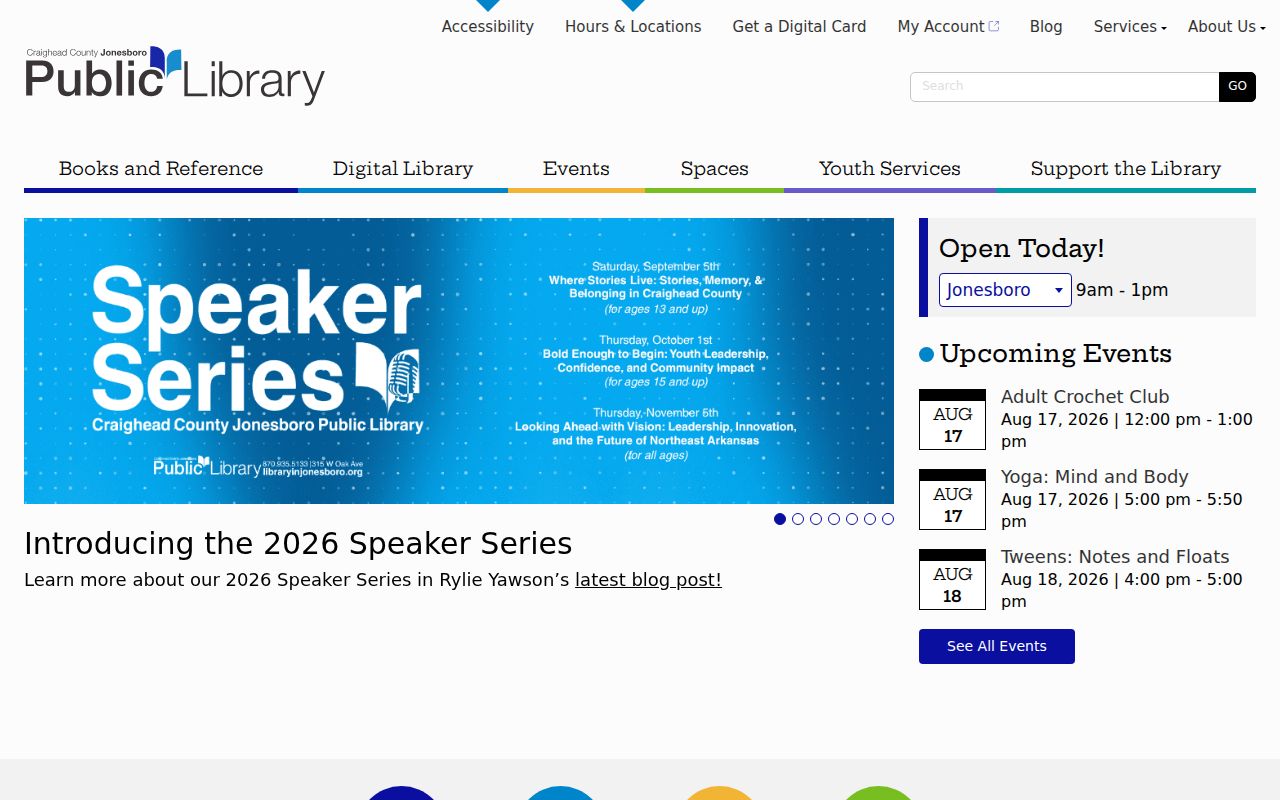
Those tools complement the directory shelf. Census databases test household identity, military files explain service clues, newspapers help date a move or death, and maps ground an old street address. Access rules vary, and Ancestry Library is commonly limited to in-library use, so confirm the current terms with staff before a visit.
Reading Jonesboro City Directory Entries
A historical Jonesboro directory entry must be read within its own volume. Names may be reduced to initials. A spouse can appear in parentheses. An occupation or employer may help separate two people with the same name. The residence may use an abbreviation such as “r,” while “bds” can mark boarding, but no shorthand should be expanded until the volume's key confirms it. Telephone books tend to show less detail and omit people without listed service.
| Indexed name | Preserve surname, initials, suffix, and printed spelling. |
|---|---|
| Spouse notation | Record the spouse exactly when the entry supplies one. |
| Work clue | Note occupation and employer or workplace without treating it as a home address. |
| Residence line | Capture house number, street, route, or boarding notation as printed. |
| Status clue | Keep a widow notation or owner mark only when the volume defines it. |
A good transcription also cites the page and year. Photograph the title page and key before copying entries. Publication may lag the canvass by months, so the year is a dated lead rather than proof that a person remained at that address for all twelve months.
- Criss-cross directory
- A section arranged by street and house number, moving from an address to a listed occupant.
- Householder index
- An address-oriented list of named householders, which may omit other people in the home.
- Abbreviation key
- The volume's own legend for shortened words and status marks; it controls how an entry should be read.
Jonesboro-Nettleton Telephone Directories
Library of Congress cataloging identifies Jonesboro/Nettleton white and yellow pages from November 1937 through September 1952, followed by another run from September 1953 through October 1959. The break matters. It prevents a casual claim of continuous coverage. Telephone directories may link a subscriber to a telephone number and address, yet they omit unlisted service and often provide less family or work detail than a historical volume.
Nettleton is more than a catalog label. It remains a cemetery and school-district identity even where a modern system may use Jonesboro. Search both place names, then compare the street, surname, and date. For a present-day address-keyed record chain, the Jonesboro street directory separates modern parcel evidence from these historical subscriber lists.
Jonesboro Directory Census Bridges
Federal population schedules are public through 1950 under the 72-year rule. The 1960 census is due in 2032. Pairing them with the Jonesboro directory years turns isolated name hits into a household timeline. The 1906 directory belongs between the 1900 and 1910 schedules. Midcentury volumes can be tested against the 1940 and 1950 census. A directory supplies an address and occupation between census decades, while the census adds relationships, ages, birthplaces, and occupancy status.
The most useful sequence keeps each record in its lane:
- Start with a confirmed directory year and copy the entry exactly.
- Search the prior and next public census for the same name, spouse, and place.
- Test initials, spelling variants, employers, and Jonesboro or Nettleton wording.
- Compare street and house number, then note any route-style address that blocks an exact match.
- Use a deed, obituary, cemetery record, or probate file to confirm the transition.
A person missing from one volume may have moved, died, gone unlisted, or fallen outside that book's scope. A no-result is weak evidence. Search adjacent years and other household names before deciding the Jonesboro trail ends.
Jonesboro's 1919 Directory Map
The Library of Congress July 1919 Sanborn set contains 30 sheets for Jonesboro. Fire-insurance maps show building footprints, construction, street names, street numbers, and building uses. They do not name occupants. That makes the set a structural bridge between the digitized 1906 directory and the confirmed midcentury runs, not another resident list.
Match a directory address to the correct sheet, then compare the footprint and use. If a house number or road name changed, carry forward the legal description and plat rather than trusting the postal string alone. The public library's licensed Sanborn database may hold other years, but exact local coverage should be confirmed with reference staff.
The confirmed Jonesboro sequence forms a practical records timeline:
- 1906: the digitized local directory supplies an early name and address snapshot.
- July 1919: the Sanborn set records the built environment across 30 sheets.
- 1936 to 1959: selected city volumes and cataloged telephone runs add midcentury address points.
- 1950: the latest public federal census provides the household comparison point.
Note: The 1919 map supports an address finding only when a directory, deed, census, or other named-person source supplies the identity.
Jonesboro Directory Obituary Endpoints
The GSCCA research site joins the 1906 directory with a Jonesboro Sun obituary index, a Craighead County marriage index, newsletters, cemetery volumes, and indexed county census publications. An obituary lead can explain why a name disappears from a later directory. It may also name relatives, a former community, a service, or a cemetery. Retrieve the full notice from newspaper microfilm when the web index supplies only a citation.
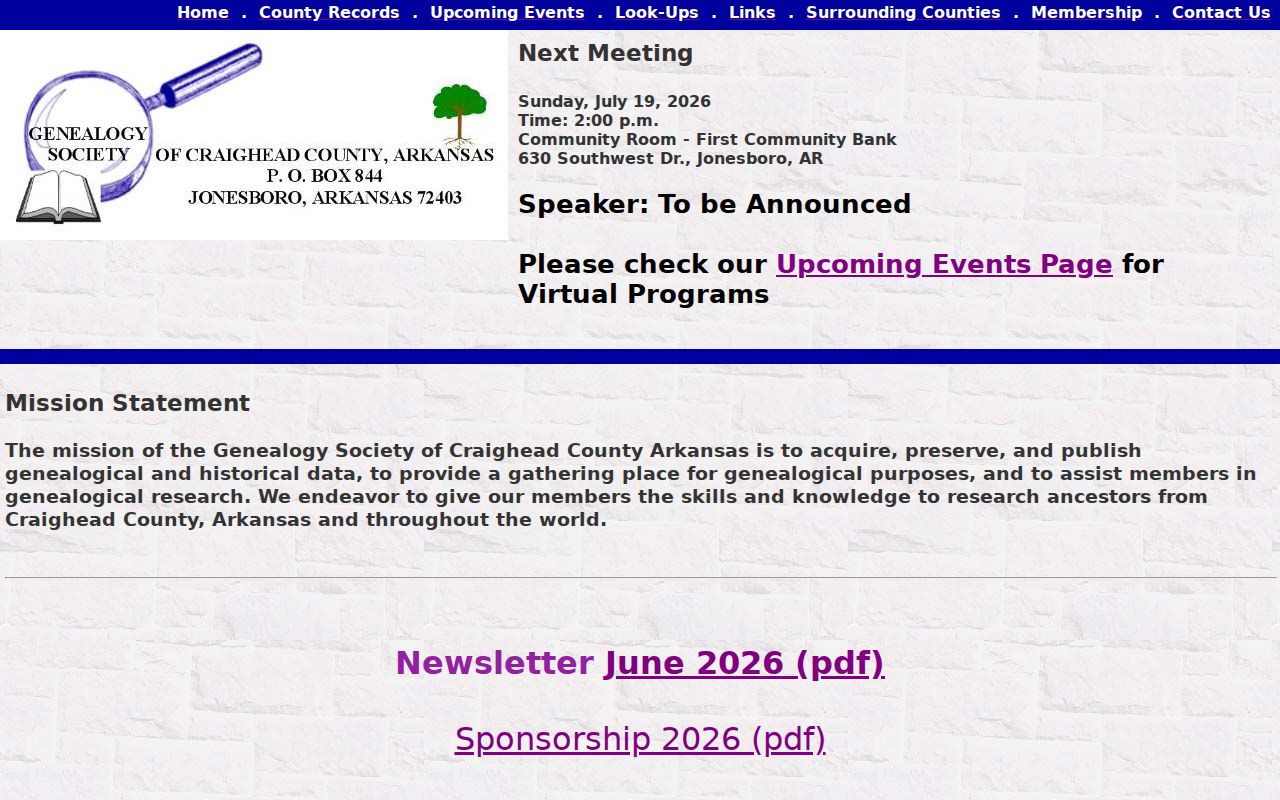
The captured society page illustrates the local index layer. Its entries are discovery tools. Confirm the person with the printed notice, a municipal cemetery plot record, probate material, or another record that matches name, date, and place. Arkansas State University archives and special collections can add yearbooks, student publications, photos, oral histories, and regional manuscripts when a directory occupation or affiliation points there.
Jonesboro Cemetery Directory Clues
Jonesboro's municipal system spans four cemeteries, more than 125 acres, and more than 14,000 burials. The city cemetery information page covers City Cemetery, Knights of Pythias Cemetery, Nettleton Cemetery, and Oaklawn, formerly called Woodlawn. That former name is a key search clue. A death notice or old directory may use Woodlawn, while the current office uses Oaklawn.
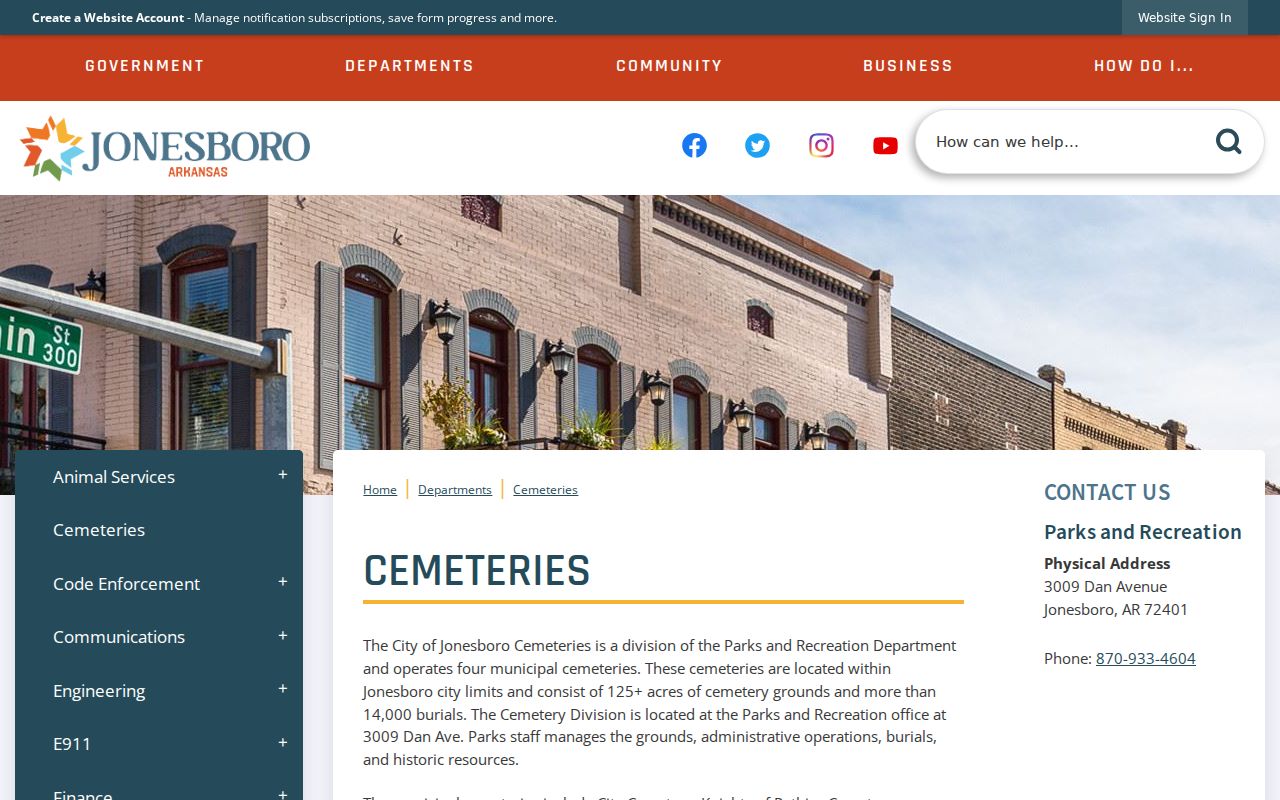
The cemetery page leads to plot-information help and available maps. Maps exist for Nettleton and Oaklawn, while the city says no map is currently available for City Cemetery or Knights of Pythias. Call the Cemetery Division at 870-933-4604 when a historical directory trail reaches a death or family grouping that the online map cannot resolve.
Trace Jonesboro Directory Households
A sound household trace does not merge every matching surname. Begin with the strongest dated entry. Keep the person's printed name, role, spouse, work clue, and address separate. Then move to the next available volume rather than assuming the missing years. Use the census for household structure, the Sanborn map for the building, and land records only when ownership matters. A deed proves a transfer, not who slept in the house.
When online access stops, use the full local fallback chain. Contact the Craighead County Jonesboro Public Library at 870-935-5133 for its historical volumes, telephone books, newspaper microfilm, and database holdings. Its stated hours are Monday through Friday, 9 a.m. to 6 p.m., and Saturday, 9 a.m. to 1 p.m. Ask GSCCA about its indexed material, the Library of Congress for its cataloged phone runs and map images, and Arkansas State University archives by organization or date. For a modern name that needs official verification, shift to the Jonesboro resident lookup rather than stretching a historical directory beyond its date.
The final trail should show uncertainty. Cite every volume and page. Note each spelling change. Mark whether a source reports residence, subscription, work, ownership, burial, or family connection. That disciplined record makes the Jonesboro city directory evidence useful without turning a clue into a claim it cannot support.